
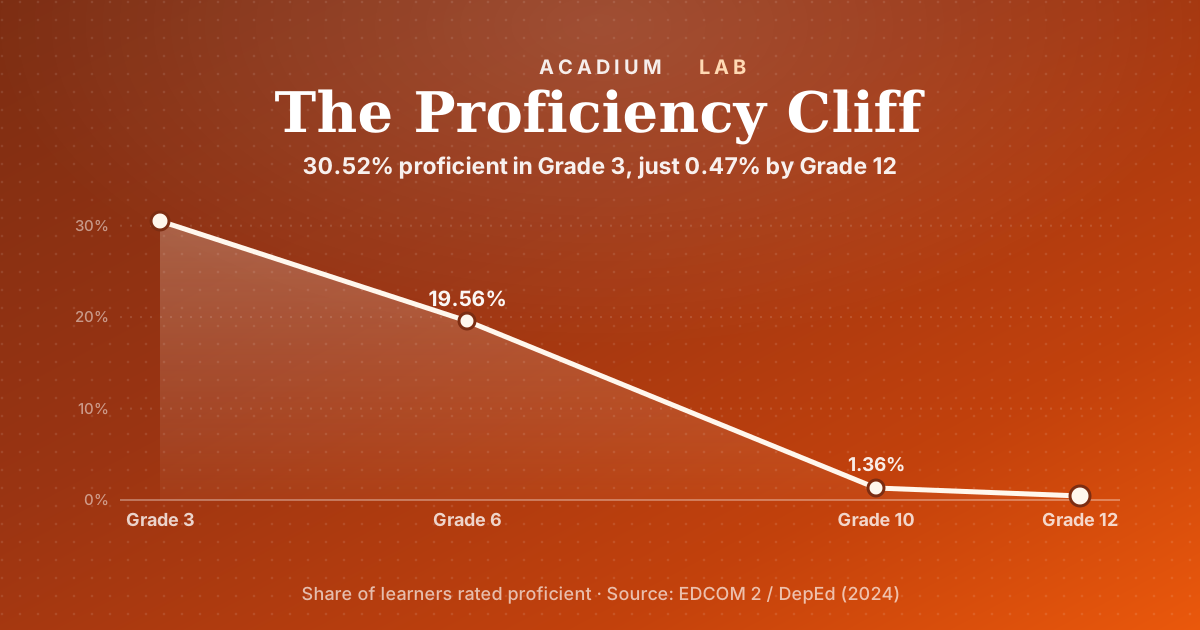
There is a single number that should reframe how Philippine schools think about student performance. According to EDCOM 2, citing the Department of Education's 2024 assessments, the share of learners rated proficient-to-highly-proficient falls from 30.52% in Grade 3 to 19.56% in Grade 6, to 1.36% in Grade 10, and to just 0.47% by Grade 12 — roughly five in every thousand graduating students.
What's striking isn't only how low the final number is. It's the shape of the decline. Proficiency doesn't collapse in one bad year. It erodes a little at a time, grade after grade, in a way that rarely shows up clearly on any single report card.
A Passing Grade Is a Lagging Indicator
A grade is a summary. It rolls weeks of work into one number, averages across topics, and arrives after the grading period is over. A student can pass — clearing the 75% line — while quietly losing the foundational skills the next grade level assumes they already have.
International data shows how wide the gap between "passing" and "proficient" can be. In PISA 2022, only 16% of Filipino 15-year-olds reached at least the baseline (Level 2) of mathematics proficiency, compared with an OECD average of 69%. The Philippines scored 355 in mathematics — among the lowest of the 81 participating countries and economies. Many of those students were not failing their classes. They were passing, and still well below the level the assessment considers functional.
The Gap Compounds, Quietly
The reason the cliff is so steep is that small gaps compound. A learner who never fully mastered fractions in Grade 5 doesn't fail Grade 6 — they just struggle a little more with ratios, then a little more with algebra, then a little more with everything that depends on it. Each step is survivable on its own. The accumulation is not.
The foundational picture makes this concrete. The World Bank estimates that about 91% of Filipino children cannot read and understand a simple, age-appropriate text by age 10. And the 2024 FLEMMS survey from the Philippine Statistics Authority found that while 93.1% of Filipinos aged 10–64 have basic literacy, only 70.8% are functionally literate — a 22-point gap between being able to read words and being able to understand them. When comprehension is shaky from the start, every later subject inherits the weakness.
By Report-Card Season, the Window Has Closed
Most schools find out a student is in trouble at the same moment everyone else does: when grades are computed. By then the grading period is over, the next unit has started, and the gap has already widened. The intervention that would have worked in week three is now a remediation problem.
It isn't that teachers don't care or can't see it. It's that the signal is buried. The evidence of a slipping student is real — a dipping quiz score here, a missed competency there, a reading passage that took twice as long — but it's scattered across separate quizzes, essays, and gradebooks, and Filipino teachers already work an average of 52 hours a week. Asking them to manually assemble an early-warning picture for every student, every week, on top of that load, isn't realistic.
What It Looks Like to Catch It Weekly
This is the gap AcadiumLab is built to close. The premise is simple: the work teachers already do — quizzes, essays, graded assignments — is data. Captured in one place, it can be read every week instead of every term.
From that everyday activity, AcadiumLab compiles a weekly snapshot per student and runs a set of independent detectors over it. They look for the patterns that precede a fall: reading-comprehension strain, a rote-versus-mastery transfer gap, early-dropout patterns, missing-work spirals, and "silent strugglers" — learners who still look fine on the surface but are quietly sliding. None of this predicts the future with certainty; it surfaces the early evidence that's already there, in time to act on it.
And detection only matters if it leads to action. When a teacher or school launches an intervention, AcadiumLab tracks it from a baseline score to an outcome score, so the question stops being "did we do something?" and becomes "did it work?"
Detection Is Only Half of It
The proficiency cliff isn't inevitable. It's the visible result of small, recoverable gaps that no one caught in time. The numbers are alarming precisely because the failures are quiet.
Making them loud — weekly, per student, in plain language — is the first step toward a different Grade 12 number. That's the job AcadiumLab is built for: turning the everyday work of teaching into a signal a school can act on while there's still time.